Blog post

Four foundations to get your brand AI-ready for the holidays

September 17, 2026
Child and adult embrace beside a freshly baked holiday pie in a festive kitchen

Prepare your brand for AI-driven holiday shopping by strengthening four foundations: product feeds, measurement, campaign performance, and AI visibility. Acting early gives systems time to learn, improves product discovery, and creates a smoother path from shopper inspiration to purchase. And for more step-by-step strategies to win on who you reach this season, check out our latest guide: Unwrapping Performance: The Advertising Holiday Playbook.

AI is changing how people discover, compare, and choose holiday gifts. Shoppers can now move from gift inspiration to product comparison in a single AI-assisted journey. And to connect them with the right products, AI systems need clear information about your brand and product catalog. 

Ensuring your brand and product signals are set up correctly now will help strengthen your holiday strategy and give AI experiences the context to present your offers with confidence.

Now’s the time to finalize your holiday AI demand strategy. Product data and measurement need time to establish reliable baselines, and automated campaigns need time to learn before holiday demand peaks.

These four capabilities work together to help your holiday strategy respond as shopper intent rises...

  1. Feed readiness: Give AI systems complete, current product information.

  2. Measurement readiness: Connect the signals that show which interactions create value.

  3. Campaign readiness: Give automated strategies the structure and time they need to learn.

  4. AI readiness: Help AI experiences find, understand, and refer shoppers to your brand.

Clear, structured product data helps AI understand your catalog and select relevant products for shoppers. If your feed includes only advertised items, AI-powered experiences may overlook the rest of your offerings.

What to check now

Ensure that you’ve:

  • Uploaded your full eligible catalog, not only the products used in ads.
  • Updated inventory, Universal Commerce Protocol (UCP) attributes, and store policies so AI systems can understand product relevance, availability, purchase terms, and fulfillment details.
  • Audited your feed and resolve Merchant Center alerts before peak demand.
  • Used custom labels to identify holiday hero products, gift ideas, and seasonal priorities.
  • Created a separate Merchant promotions feed to highlight your holiday promotional offers, discounts, and sale pricing. 
     

A complete, accurate feed supports paid and organic discovery, expands the details AI systems can evaluate, and gives more relevant products a chance to be considered instead of hidden from both AI systems and shoppers.

From there, measurement then shows which product interactions lead to valuable outcomes.

Effective measurement shows whether traffic from AI experiences and campaigns produces valuable outcomes for your brand.

What to check now

You’ll want to make sure you’ve:

  • Connected Universal Event Tracking (UET) and Conversions API (CAPI) data across your website, app, CRM, and offline sources so online and offline outcomes can be measured together.
  • Passed conversion values as well as conversion counts.
  • Validated each priority conversion goal with the “Test This Goal” feature in Microsoft Advertising, and used the relevant Copilot prompt to troubleshoot any setup issues before traffic arrives.

These steps help automated bidding identify high-value outcomes, allocate budget efficiently, and adapt as holiday demand peaks. Connecting online and offline results also helps prioritize revenue and return rather than conversion volume alone.

Once you’ve identified measurement outcomes, your campaigns will need enough conversion data and a stable learning period to optimize toward those goals before demand peaks.

AI systems perform best when they have sufficient data and clear optimization signals. If you have data volume issues, now’s the time to restructure and consolidate to build campaign structures that accelerate learning.

Campaigns with fewer than 30 conversions in 30 days may give bidding strategies less data to learn from, which can make performance more volatile. By consolidating fragmented campaigns, your brand can build a stronger signal base before holiday demand peaks.

What to check now

Make sure you’ve:

  • Consolidated fragmented campaigns to strengthen the signal base, and allowed at least four weeks for new bidding strategies to stabilize.
  • Used broad match, AI Max, and Performance Max to capture new query opportunities across Bing Search, Copilot, and other surfaces–especially conversational queries in AI experiences.
  • Used conversion-based auto-bidding strategies to help you optimize toward your goals with the full breadth of auction and user signals.
  • Kept each budget or target adjustment modest—about 15% from the current setting at a time—so the bidding strategy can adapt without a disruptive reset.
  • Ran structured A/B experiments while traffic is stable enough to produce clean learnings.

Following these steps gives your campaigns a stronger basis for allocating spend, responding to demand shifts, and capturing incremental conversions without sacrificing efficiency.


Amsive used AI-driven bidding and automation to adapt to demand in real time and capture more value from high-intent traffic during peak periods, resulting in 1,042% ROAS while reaching profitability 2X faster.


AI assistants and agents are becoming an important source of discovery, even as the broader web continues to drive most holiday traffic. Understanding how AI experiences find and refer shoppers establishes your visibility baseline. 

What to check now

Make sure your brand is being found by AI by ensuring that you’ve:

  • Set up Microsoft Clarity to establish a baseline performance and understand how your pages and content are being found and chosen by AI
  • Compared AI-referred visitors with visitors from other sources using Clarity.
  • Used AI Visibility reporting to see how your content is cited, where you stand against competitors, and what opportunities to act on.
  • Set up Brand Agents on your website to give every customer a personal shopper and boost conversions. 
  • Looked at Clarity’s heatmaps and session recordings to see exactly what visitors do after they land to make on-site improvements that turn more visitors into customers.

And for more practical guidance on helping your brand show up in AI recommendations, check out our playbook: Prepare for the Age of AI Shopping.


Alexander Del Rossa saw over 3X higher conversion rates in Brand Agent-assisted sessions compared to unassisted sessions over 30 days.1


It’s important for your brand to have these preparations in place well before November. New bidding strategies need at least four weeks to stabilize, and product data, measurement, and AI visibility baselines also need time to produce useful signals. 

When all four foundations work together, they create a clear path from AI-assisted discovery to a confident purchase while keeping your brand visible throughout the journey.

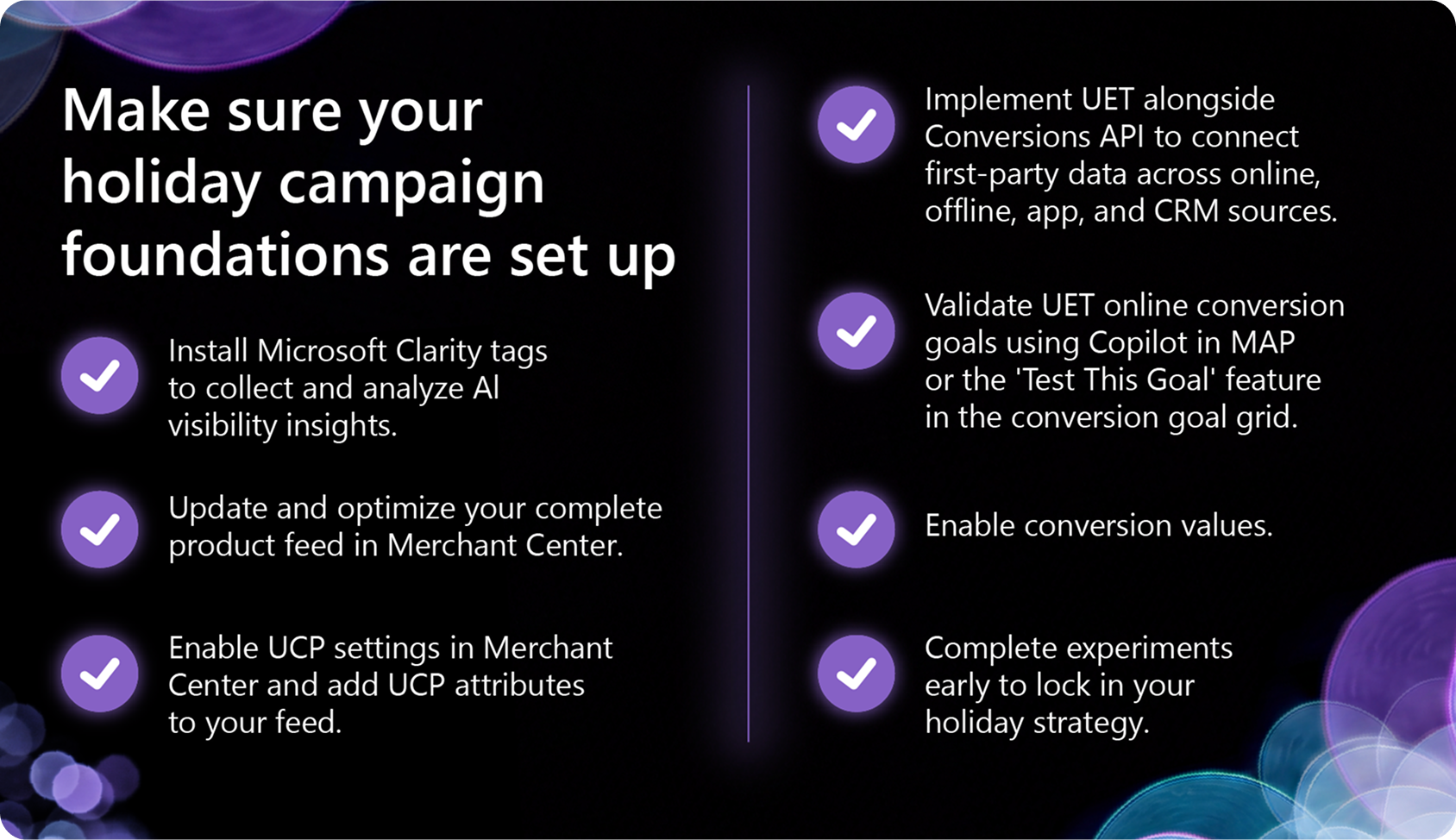
Use the list below to check that your brand’s AI holiday shopping strategy is ready before the peak.


Image of a holiday campaign foundations readiness checklist with reminders on setting up product feeds and campaigns and tracking measurement and AI visibility for peak shopping demand.


For more ways to prepare your campaigns, product data, and measurement for the holiday season, check out our 2026 holiday guide: Unwrapping Performance: The Advertising Holiday Playbook.

Have more questions? Contact a Microsoft Advertising expert to get personalized guidance, discover beta programs, and unlock holiday campaign support.


[1] Based on total number of conversions from assisted vs. unassisted sessions from November 8, 2025 to December 8, 2025.

Authors

  • Amanda Silvernale

    Amanda Silvernale

    SENIOR DIRECTOR PRODUCT MARKETING, MICROSOFT AI