Blog post
All in on AI Series: Agentic Commerce

It’s hard to believe we’re already in May - and what a pivotal time to explore the future of Agentic Commerce”. Earlier this year, we kicked off 2026 with several major announcements at NRF, and since then the industry, agencies, and brands have been rapidly reshaping how they capture a new kind of AI‑driven demand.
In this month’s All in on AI Leader Series, we sit down with retail industry guru Roger Dunn to explore how he sees this shift is disrupting retail. Roger is a retail media leader with over 20 years of experience spanning every side of the industry, from advertiser and agency to AdTech, publisher and consultancy. He is also the author of The AI Commerce Brief where he shares quick insights on AI commerce, agentic shopping, and the shifts reshaping commerce and retail media, on a weekly basis.
Responses below attributed to Roger Dunn
When AI agents begin doing the shortlisting, who are brands really persuading, the shopper or the shopper's AI? What becomes the new foundation of trust in that world?
The honest answer is both, but in a new sequence.
What's changed is that AI is increasingly deciding who gets the chance to persuade the human. This is what I've been calling the ‘Shortlist Economy’. When someone asks ChatGPT, Copilot, or Gemini for a product recommendation, the AI assembles a shortlist, usually three to five options, and that shortlist becomes the only consideration set that matters. If you're not on it, you don't get to make your case. It doesn't matter how good your brand campaign is if the agent never surfaces you.
The vast majority of consumers still verify AI recommendations before buying. They take that shortlist to Google, to Bing, to a brand website, to YouTube. The verification stage is a confirmation exercise, not an open-ended one. They're searching for the specific brands the AI mentioned, not starting from scratch. So traditional brand equity still matters enormously at that point. The brand the consumer already trusts gets the click.
So trust now operates in two layers.
First, there's machine trust. From a retailer’s perspective - can an AI agent find you, understand what you sell, and have confidence that your product data is accurate and current? That's about structured data, reviews, fulfillment reliability, pricing consistency. It's operational, not emotional.
Second, there's human trust. When the consumer arrives to verify, does your brand have the credibility, the reputation, the experience to close the deal? That's the brand equity layer, and it's not going away.
The brands that win will be the ones who treat product data as a strategic asset while continuing to invest in the emotional signals that make humans want to buy. The mistake is thinking you have to choose.
Which signals matter most and where do you see trust breaking down first?
Product truth comes first signal to matter most, and it's non-negotiable. AI agents reason over structured attributes: dimensions, compatibility, features, use cases. If those attributes don't exist as machine-readable data, you're not even a candidate. In the old world, poor data meant lower conversion. In the agentic world, poor data means you never enter consideration. Consumers aren't prompting "what's a good shoe brand." They're saying "I'm running a 5K this weekend on mixed terrain and my feet run narrow." If your catalogue can't answer that level of specificity, the agent recommends someone who can.
Reviews and third-party signals come second. AI systems synthesise review sentiment to answer highly specific questions. One detailed review explaining how a product performed in a real scenario is worth dozens of generic five-star ratings. Third-party endorsements, expert mentions, and certifications act as trust multipliers that AI increasingly weights.
Fulfillment reliability is third and rising fast. As we move up the automation curve, especially when consumers start authorising agents to purchase within preset rules, delivery reliability becomes a make-or-break signal. If an agent places an order and the delivery fails, the agent learns. Your logistics will become your trust score.
Brand authority is fourth. Still vital, but its mechanism is shifting from emotional halo to verifiable digital identity. Your reputation is increasingly a technical credential that agents use to evaluate trustworthiness.
Retail media investment is where trust breaks down first. The traditional model depends on sponsored placements during browsing sessions. But more than 60% of retail media ad spend is tied to on-site search. If discovery shifts upstream to AI assistants, that revenue model is under pressure. Brands paying for prominence without underlying product quality will be the first to get exposed. The question of how sponsored products survive when visibility depends on relevance rather than bid prices is genuinely unresolved – but AI ads are only in their firs innings, so more to come here.
What are the key topics CMOs want to learn about and how do you see Brand Agents and onsite conversational commerce playing a role?
Three topics dominate every conversation I have with brand-side leaders right now.
First is the discoverability question: "How do we show up in AI?" Most CMOs have realised their products are being recommended (or not) across ChatGPT, Gemini, Copilot, and Perplexity, and they have almost zero visibility into why. This is where the AEO/GEO/ACO framework I've been sharing comes up constantly. AEO gets you discovered through structured product data. GEO makes you credible through reviews and third-party endorsement. ACO converts that into a completed transaction. CMOs want to understand these as connected disciplines, not siloed projects.
Second is the relationship question: "What's my direct customer relationship worth in an agent-mediated world?" If consumers increasingly discover products through AI intermediaries, brands with direct relationships (loyalty programs, first-party data, email) maintain a structural advantage. There's real anxiety about ceding customer access to third-party AI platforms.
Third is measurement: "How do we attribute any of this?" Attribution breaks down when someone asks ChatGPT or Copilot for a recommendation and buys based on it. Last-click models don't capture that journey. The honest answer is the industry is still building the tools, this can be unsettling but it’s such a new space.
On Brand Agents specifically, this is where the conversation gets genuinely exciting. We're seeing the emergence of AI-powered brand representatives that can engage consumers in the brand's own voice, whether that's on a retailer's site, inside a search experience, or within a brand's own properties. Microsoft is piloting agents with brands that let shoppers chat directly with the brand onsite – then link that through to Bing and Search.
The bigger picture is an ecosystem where Customer Agents (the consumer's AI) interact with Brand Agents and Category Agents that represent product lines, merchandising logic, and brand voice. For onsite conversational commerce, the opportunity is to deploy these as sophisticated shopping advisors, guiding discovery through natural dialogue, explaining trade-offs, learning preferences over time. The brands that build these capabilities now will own those customer relationships directly. The alternative is ceding them entirely to third-party platforms.
How do you see capabilities like Checkout influencing consumers and brands' ability to grow?
In-conversation checkout, through ACP and UCP, is the most consequential infrastructure shift in commerce since the mobile app store. Not because of what it does today, but because of what it makes possible.
Checkout inside an AI conversation collapses the entire purchase funnel into a single conversational thread. The consumer describes a need, the agent recommends, the consumer selects, and the purchase completes, without opening a browser tab or navigating a checkout flow. That's structural, not incremental.
The ACP story has been fascinating to watch. Originally positioned as the universal commerce protocol, it launched with the vision that any Stripe merchant could enable agentic payments almost instantly. In practice, OpenAI pivoted toward deep retailer app partnerships (Target, Instacart, DoorDash) creating a two-tier system. Major retailers get full in-chat checkout. Smaller merchants get product discovery with a link back to their site. ACP's role shifted from universal connector to infrastructure for bespoke partnerships.
UCP takes a different approach, built for scale. Google Merchant Center already hosts catalogues from millions of merchants. Microsoft is also building commerce capabilities into Copilot that leverage similar standardised approaches. When platforms like Shopify or Salesforce Commerce Cloud support these protocols natively, every merchant on those platforms gains agentic commerce capability through configuration rather than custom engineering. That middleware adoption path could compress onboarding from years to quarters.
For brands, the growth implication is clear: if your products are discoverable and purchasable through conversational checkout, you're operating in a channel that compresses the funnel, increases conversion intent, and captures demand at the moment it forms. The strategic imperative is ensuring you're transactable through at least one protocol, and ideally positioned across multiple ecosystems including ChatGPT, Google, and Microsoft Copilot. The brands that move early will gain data and experience that compounds as this channel scales.
What's the one bet you'd tell a CMO to focus on for the next 12 to 18 months, and what would you stop focusing on?
The bet: Product data enrichment and agent readiness.
Unglamorous, I know. But it's the highest-leverage investment available right now. In the age of AI recommendations, your product data is your shelf placement. If your catalogue is sparse or inconsistent, you're not just underperforming, you're invisible.
Practically, that means enriching product content beyond basic specs. Use cases, compatibility information, contextual guidance, the kind of detail a great salesperson would offer. Deploy proper schema markup. Sync pricing and inventory in real time across feeds and your site. Make sure what the AI sees in your feed matches what it sees on your page. And ensure you're feeding clean, structured data into Microsoft Merchant Center and Google Merchant Center alike, because Copilot and Gemini are both pulling from those feeds.
This investment compounds regardless of which future scenario plays out. Whether we end up with many agents and open protocols, or a few dominant platforms, or creator-led discovery, machine-readable, contextually rich product data pays off in every version. And there's a real first-mover dynamic: the competitive advantage in AI visibility is forming now, and the window is measured in quarters. What to reduce: Undifferentiated upper-funnel display spend.
Not brand building (brand equity is getting more important, not less). But the generic programmatic display that many brands default to is delivering diminishing returns and will be further diminished by agent-mediated discovery. That budget is better redeployed toward the data work described above, toward cultivating rich and authentic reviews, and toward building first-party data relationships that let you reach customers directly regardless of which AI platform mediates discovery.
If you could instantly amplify one capability across a global retailer or brand org, what would it be?
Unified, real-time, machine-readable product data, federated from a single source of truth across every surface, every protocol, and every agent. It's the unglamorous answer, and that's exactly why it's the right one. Every other capability in agentic commerce depends on this foundation. AI visibility, conversational checkout, agent-readiness, measurement: all of it breaks if your product data is incomplete, inconsistent, or stale.
LLMs build complex mental maps from the content and context they're given. When a consumer prompts with a richly specific request (a situation, not a keyword) the AI ties together contextual clues to make matches that feel almost magical. But it can only work with what it's been given. If your data doesn't explain who a product is for, when it performs best, and why customers love it, the agent recommends someone who does. The beauty of this capability is that it's not a bet on one platform or one scenario. It makes you discoverable through ChatGPT and Google and Microsoft Copilot and Perplexity and Amazon and whatever comes next. It powers your onsite conversational commerce and your offsite agent visibility simultaneously. It serves research queries today and fully autonomous purchasing tomorrow.
And here's the competitive reality that makes this exciting: the Shortlist Economy rewards data quality over brand size and ad spend. A well-described challenger can break into AI shortlists because those shortlists are inherently open to newcomers. You can't lock down a permanent position, but you can maintain a high batting average of inclusion by being consistently the most useful, most complete, most trustworthy answer to the question the consumer is actually asking. The organisation that makes every product across every market machine-readable, contextually rich, and accurate in real time: that's the one that wins. Everything else is downstream.
Responses attributed to Adam Goodman, Director of AI in Advertising APAC:
Watching how brands adapt to this shift makes one thing clear: this isn’t just about adopting new tools—it’s about operating in a fundamentally different system.
A few core themes from Roger’s answers stood out: trust, structured data and product truth, and the role of knowledge and value in influencing decisions. To help retailers and merchants of all sizes, we’re thrilled to launch a new Agentic Commerce resource page - bringing together resources on Brand Agents, Copilot Checkout, AI visibility insights from Microsoft Clarity, and more.
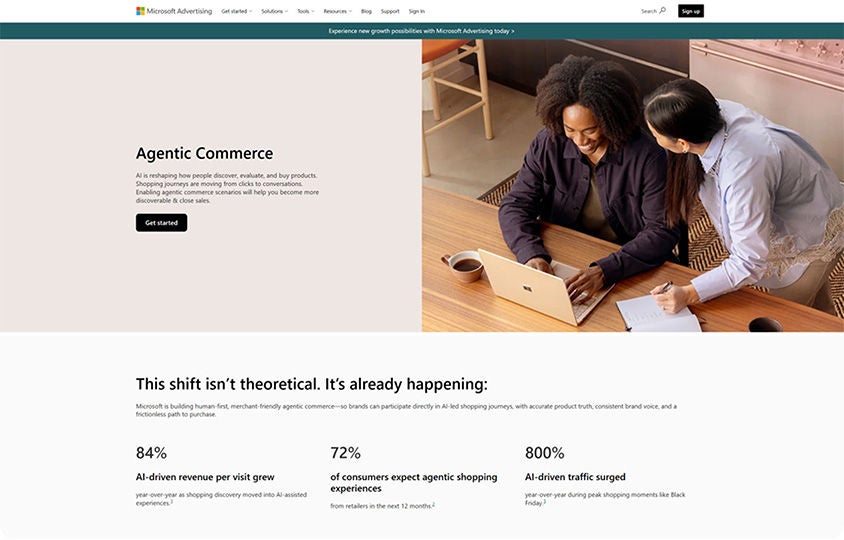
Businesses have a huge opportunity to engage consumers through more conversational interfaces while still delivering exceptional experiences - both within AI assistants and on-site. Microsoft’s grounding technology now powers many of the AI assistants in the market, so as brands think about how to be discoverable, cited, and trusted, it’s important they understand what underpins those experiences.
At Microsoft, our focus is to help brands navigate and activate against this opportunity. From understanding how they show up in AI-driven environments, to enabling more direct engagement through Brand Agents, to connecting discovery to transaction through Copilot-powered commerce, we’re building the infrastructure that supports this new model end-to-end.
As we wrap this month’s topic, the question for every marketer is a simple one: where are you on your agentic commerce journey?
Some of what we’ve covered here will resonate immediately. Some will take shape over time.
But as Tim Frank, CVP of Microsoft AI, puts it: “The foundation you build today determines what you capture tomorrow”.
We’ll be continuing the conversation next month with All in on AI: Accelerating Creativity, where we’ll be talking with AI leaders ‘live’ from Cannes Lions’ Festival of Creativity. If you are attending and want to join us – you can register here to attend the Microsoft Gardens and Beach House. Hope to see you there!

Your input makes us better
Take our quick 3-minute survey and help us transform your website experience.