Blog post
Understand how humans and AI find and choose your brand with Microsoft Clarity
Paid search marketers spend a lot of time optimizing what happens before the click.
You build and refine targets, test creative, and analyze search terms.
However, one of the biggest sources of performance gains often happens after the click.
When a campaign underperforms, it's easy to assume the problem is targeting, bidding, audience quality, or creative. Sometimes that's true. But often times, the issue is that visitors arrive on the landing page and don't know what to do next.
Marketers are also facing a second challenge. More customer journeys now involve AI experiences before a website visit ever occurs. LLMs and agents are increasingly becoming the consumer’s personal shopper, curating recommendations and influencing—or even deciding—their final purchases.
That's why modern marketers need modern insights that help answer two questions:
- How are AI systems discovering and representing my brand?
- What happens after someone reaches my website, especially if AI referred them?
Microsoft Clarity helps answer both questions in a privacy compliant way.
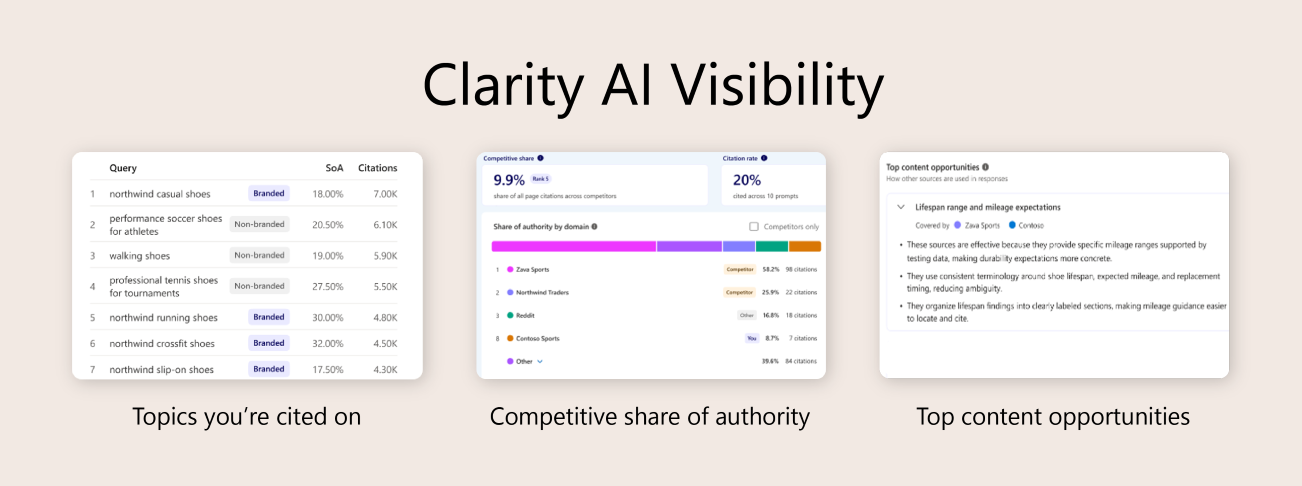
Clarity’s AI Visibility capabilities help marketers understand how AI systems discover, interpret, and cite their content. AI Visibility includes reporting on grounding queries, citations, share of authority, and competitive topic visibility, helping marketers understand how AI systems retrieve and reference information about their brand.
Its behavioral analytics capabilities then help marketers understand what visitors do after they arrive.
Together, these insights create a more complete view of the customer journey.
Pair search term transparency with new AI grounding query insights
Paid search marketers live and breathe search terms. You use them to understand customer intent, identify new opportunities, refine targeting, and improve campaign performance. Microsoft Advertising uniquely supports full search term transparency for any query resulting in a click, making search terms one of the most valuable optimization tools available to marketers.
However, AI-powered discovery works differently than traditional search.
When a person enters a search query, there’s typically a direct relationship between what they type and the results they receive. AI systems take a different approach. A single prompt often triggers a process called query fan-out, where AI breaks a complex question into multiple retrieval queries designed to gather information from different angles before generating a response.
For example, someone might ask an AI assistant: "What's the best CRM for a mid-sized B2B company with a long sales cycle?"
Before generating an answer, AI may fan that prompt out into multiple retrieval paths focused on topics such as:
- B2B CRM platforms
- CRM solutions for mid-market businesses
- Long sales cycle customer management
- CRM implementation considerations
- CRM platform comparisons
Before generating an answer, an AI system translates a single human prompt into multiple retrieval and grounding queries — run in parallel, grounded against web content, then synthesized into one response.
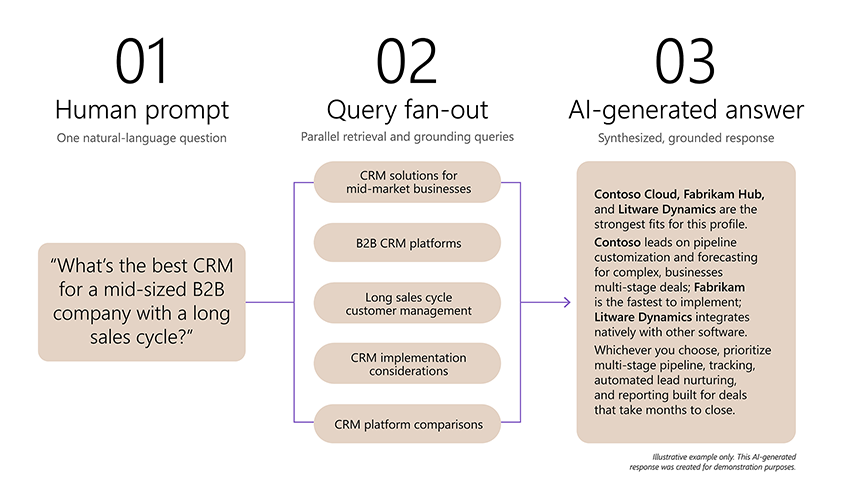
How one prompt becomes many queries
This matters because AI assistants discover and cite content through queries beyond what users type, so visibility depends on covering the full fan-out, not just the original question.
These retrieval paths are represented in Clarity through grounding queries.
Grounding queries help reveal how AI systems connect your brand and content to topics, entities, and customer needs when building an answer. Rather than showing what the human asked, they help marketers understand the information retrieval layer that sits between a user's prompt and an AI-generated response.
Historically, marketers have had limited visibility into this process. They could see rankings, clicks, and search queries, but not how AI systems interpreted a prompt before retrieving information and generating an answer. Grounding queries begin to illuminate that layer of discovery.
"What a useful new set of AI search-focused reports within Microsoft Clarity—with actionable insights to help us understand our AI search visibility, citations, market share, and content optimization opportunities! With these new AI dashboards, Clarity has become the new must-install analytics platform across all my sites and positions itself as the best free provider of AI search data."
— Aleyda Solis, International SEO Consultant & Founder, Orainti
How to action grounding queries in paid campaigns
Search terms tell you what customers searched for. Grounding queries help explain how AI systems understand the intent behind those questions when retrieving information. Together, they provide a more holistic view of modern search and discovery.
Understand how citations and content recommendations work in Clarity
Comparing the two can help paid search marketers:
- Identify emerging opportunities in customer behavior, targeting, and creative: Grounding queries reveal the topics and concepts AI associates with your brand, helping you strengthen authority in areas that matter most to your customers. If grounding queries consistently surface valuable topics that are underrepresented in your campaigns, those insights can inform new queries to potentially target, landing page content, ad creative, and audience strategies.
- Uncover new opportunities for AI-powered query matching: Valuable grounding queries can help inform better targeting strategies, including AI-powered matching solutions such as Performance Max and AI Max. These help advertisers capture new and relevant searches that may not be represented in today's keyword lists.
- Improve alignment between human and AI discovery: When search terms and grounding queries show strong overlap, it can be a signal that your content, campaigns, and website clearly communicate your expertise to both people and AI systems. If they don’t overlap, consider whether the new grounding queries are relevant to your business. If they are, you can build additional landing pages and content on these topics to improve your share of authority. If they feel disconnected from your brand, it’s a sign to take a closer look at your content and structured data to investigate how and why AI may be misinterpreting your products and services.
"Clarity takes the guesswork out of Generative Engine Optimization (GEO). Right now, we use the platform as a diagnostic tool to see which grounding queries trigger our content, and just as importantly, where competitors are outperforming us on citations. Moving forward, our plan is to scale this across our entire digital strategy by baking Clarity's content suggestions directly into our editorial briefs. By using this data to refine our formatting, improve our information density, and answer the exact prompts the LLMs are using, optimizing for AI becomes less of a guessing game."
— Heidi Sturrock, Search Marketing Advisor, SEM Insights
Competitive intelligence through AI Visibility
Once marketers understand how AI systems interpret their content, the next logical question becomes: How does our visibility compare to competitors?
This is where AI Visibility introduces an entirely new form of competitive intelligence. Instead of asking, "Where do I rank?," marketers can begin asking, "When AI systems answer questions related to my business, how often am I part of the answer compared to my competitors?"
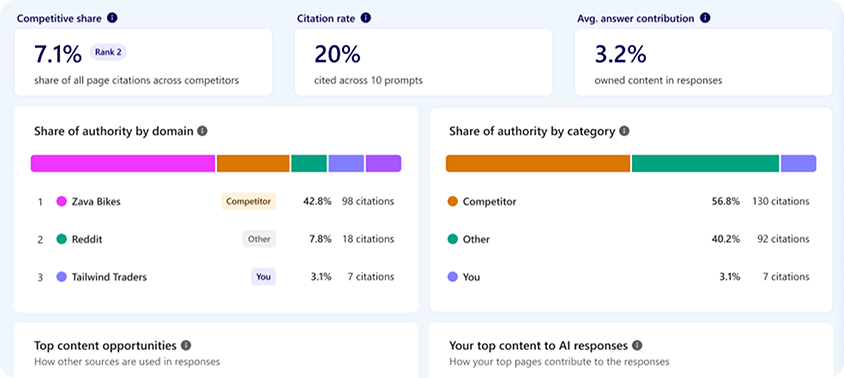
Make AI content gaps immediately actionable
"For years, visibility meant ranking in a list of links. Clarity's AI Visibility reframes that entirely. What matters now is whether AI systems are retrieving, grounding, and citing your content before a human ever searches. Share of Authority is the metric our clients have needed and didn't have a name for. Now they do."
— Simon Poulton, EVP Innovation & Growth, Tinuiti
Clarity can help identify:
- Areas where your brand earns citations and where you’re missing out.
- Topics where competitors are selected instead.
- Content recommendations to strengthen authority in weaker topic areas.
For paid media teams, this intelligence can help guide where content and advertising investments should work together.
If competitors consistently earn citations around topics where your brand has limited visibility, that may signal an opportunity to invest in both content development and paid media coverage. Conversely, if your brand is consistently cited as an authority on specific topics, that insight can help justify additional advertising investment in adjacent products, audiences, and categories that could deliver strong ROI.
"I'm excited for the new AI Visibility metric to give us feedback on what entities AI believes you are an authority on. Microsoft is leading the way in transparency in how you are being understood. This data, with known entities in your content, give you a full picture of what you are known for."
— Martha van Berkel, CEO, Schema App
The post-click blind spot is still costing marketers conversions
AI visibility insights help marketers understand discovery. Behavioral analytics help marketers understand what happens next.
Many issues that get attributed to targeting, bidding, audience quality, or creative can actually be landing page issues. Once someone reaches your website, every interaction helps explain whether the experience is supporting or undermining performance. Clarity helps marketers move beyond aggregate metrics and understand the "why” and the drivers behind how visitors experience their website.
Heatmap analysis
Heatmaps show where visitors click, scroll, and focus their attention. For paid marketers, this helps answer questions such as:
- Are visitors reaching the key value proposition highlighted in the ad?
- Are important calls-to-action being seen?
- Is critical content being missed entirely?
Instead of simply understanding where users click, the goal becomes understanding whether the experience supports the conversion path you're trying to create.
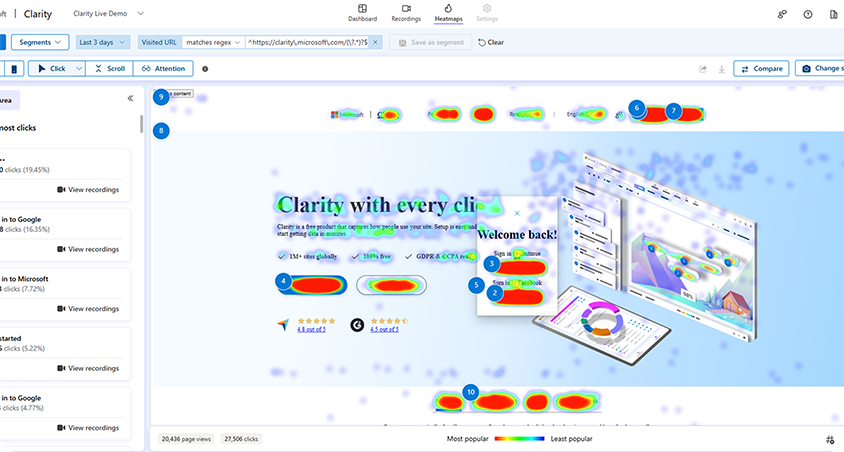
See exactly where visitors focus before they convert
Session recordings
Visitors abandoning forms, struggling with navigation, or encountering technical issues can all decrease conversion performance.
For paid media teams, reviewing session recordings makes it easier to determine whether performance issues are platform or campaign issues, or whether the landing page experience and conversion process need to be re-examined.
Behavioral signals
Rage clicks, dead clicks, excessive scrolling, and other behavioral indicators help identify friction points that might otherwise go unnoticed. Instead of guessing where users are struggling, marketers can see exactly where confusion is happening and prioritize improvements accordingly.
- Sources generating rage clicks, dead clicks, excessive scrolling, or signs of confusion: May indicate landing page issues rather than traffic quality issues.
- Sources generating strong engagement and conversion behavior: May reveal opportunities to increase investment or prioritize specific placements within your display and video media buys, including through Audience campaigns with Microsoft.
Validate why tests win
Getting clear A/B testing insights is a critical part of running paid campaigns, and understanding why one variant wins over another makes the tests actionable. The same behavioral analytics that help you understand whether your landing pages are strong also help you understand your test results and how visitors engage with different experiences.
Go beyond identifying winning and losing traffic sources to understand why traffic is performing the way it is, so you can make more informed optimization decisions. Behavioral analytics also provide context that can inform future landing pages, creative, and messaging experiments.
Why Clarity insights matter for paid media professionals
Discoverability across human and AI-powered journeys is a critical part of winning in both paid and organic efforts.
Clarity helps bridge those worlds. It shows:
- How AI systems discover and cite your brand and content through AI Visibility insights.
- What happens after the click through behavioral analytics.
And because Clarity is free, it lowers the barrier to gaining insights that previously required multiple specialized tools. It’s easy to get started today.
In a world where marketers are losing visibility into consumer search journeys with some platforms while simultaneously navigating entirely new AI-driven discovery paths, the winners will be the teams that understand both.
Enjoyed this blog post? Join our Optimize Your AI Presence with Microsoft Clarity webinar on August 27 to learn how Clarity can help strengthen your AI presence.
Your input makes us better
Take our quick 3-minute survey and help us transform your website experience.