Blog post
All in on AI Series: The Transformation Shift
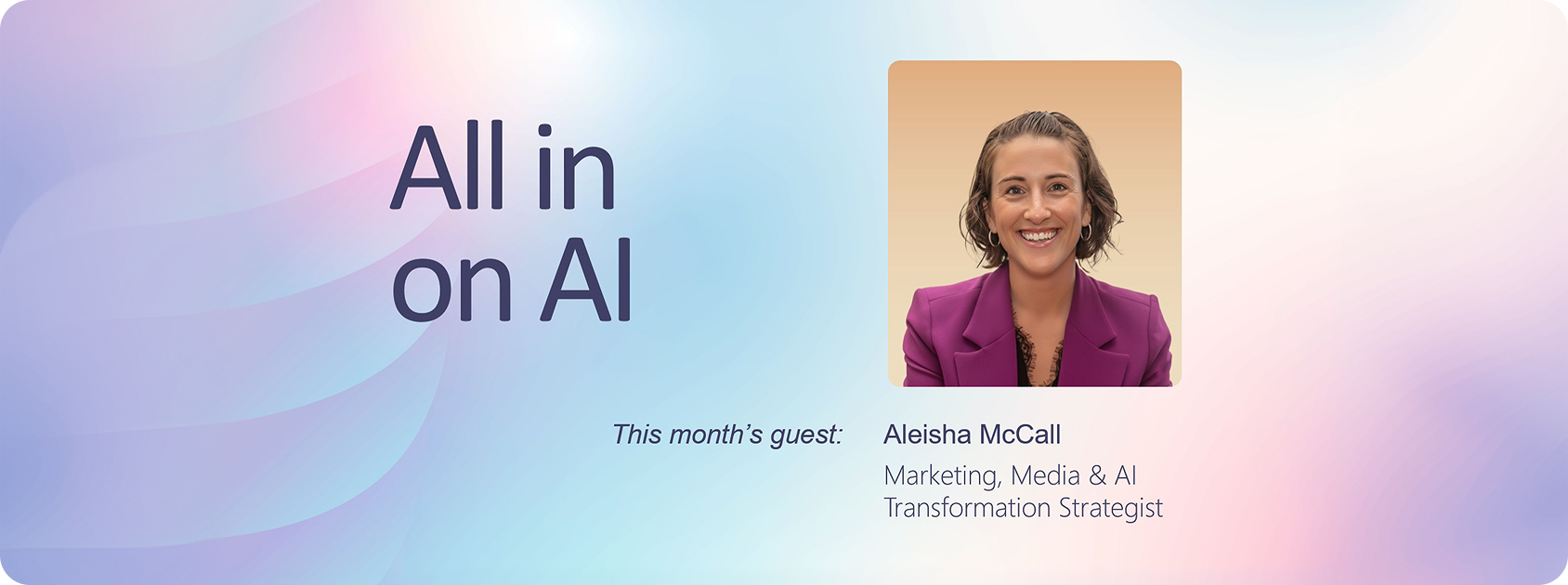
In this month’s All in on AI Leader Series, we sit down with Aleisha McCall, Founder & CEO of Ultimate Edge Communications, a marketing, media and AI transformation consultancy helping organisations redesign their marketing and media advertising operating models for the AI era. Aleisha is a Marketing, Media & AI Transformation Strategist, industry keynote speaker, multi-award winner, and a ten-time recipient of the B&T Women in Media Power List. She is also the host of The Black Box of Media podcast, where she lifts the lid on the hidden strategies behind high-performance media advertising, interviewing marketing leaders, media experts, and brand executives to uncover the tactics that consistently deliver commercial results. As Founder & CEO of Ultimate Edge Communications, she helps organisations redesign their marketing and media advertising operating models for the AI era. Working with senior executives and their teams to eliminate fragmented marketing practices, integrate AI into commercial operations, and deliver measurable, high-ROI business outcomes. Let’s jump straight in and learn more about the transformation journey we are on.
Responses below attributed to Aleisha McCall.
Across the organisations you’re seeing, what separates the ones genuinely transforming with AI from those that have simply bolted it on — and what are the transformers doing differently?
The organisations leading the way are leveraging AI opportunistically to redesign their marketing and media functions. Instead of just bolting on another tool to their already fragmented and disconnected marketing stack filled with manual processes, they’re completely reconfiguring and streamlining their systems and processes from the ground up.
The early adopters have already started documenting workflows, bringing customer data together into one consolidated view, establishing transparent governance early with a single source of truth across marketing, sales and customer experience with as many additional internal functions as practicable. This is where additional value can be extracted from more of the organisation; frictionless payment processing, including refunds, customer service and even proactive research and development for leading-edge products and services that benefit from early-stage customer feedback.
The biggest competitive opportunity in the next 6 months is available for forward-thinking marketers who can strategically establish these solid foundations to set themselves up to win the long game as the landscape continues to shift with incredible innovations and functionality. The day of reckoning will soon arrive for any laggards who continue with their short-sighted piecemeal approach.
What cautious marketers are really waiting for are the security guardrails necessary for a full integration to be effective. This is why I think most organisations are still using AI tactically and just dipping their toes in the water. They’re generating a lot more content faster, summarising meetings and getting AI to write boilerplate emails. That’s productivity improvement, but it’s not transformational.
As AI reshapes how work gets done, where are you seeing organisations struggle most: the technology, the culture, or the gap between leadership vision and frontline adoption?
The core issue with AI is that it can only automate working workflows; otherwise, it will simply amplify chaos. The reliance on humans to improvise as they do their work is the #1 impediment to effective agentic AI adoption. Without optimised workflows that have been “battlefield tested”, AI remains a silo-based task optimiser with a disharmonic approach to collaborative group-based tasks.
To make this more challenging, marketing has traditionally operated in silos. Media, CRM, creative, analytics, sales and customer service have often worked using different data sets with different measures of success metrics and KPIs.
That's why we're seeing such a strong move towards unified platforms and connected data environments. Smart CMOs know that AI performs best when it has access to consistent, (properly) governed data with clearly defined workflows (with minimal to no human improvisation).
Before asking, "Which AI tool should we buy?", the question should be, "How does work currently flow through our business today and, more importantly, if we were to improve that flow, what would we change?"
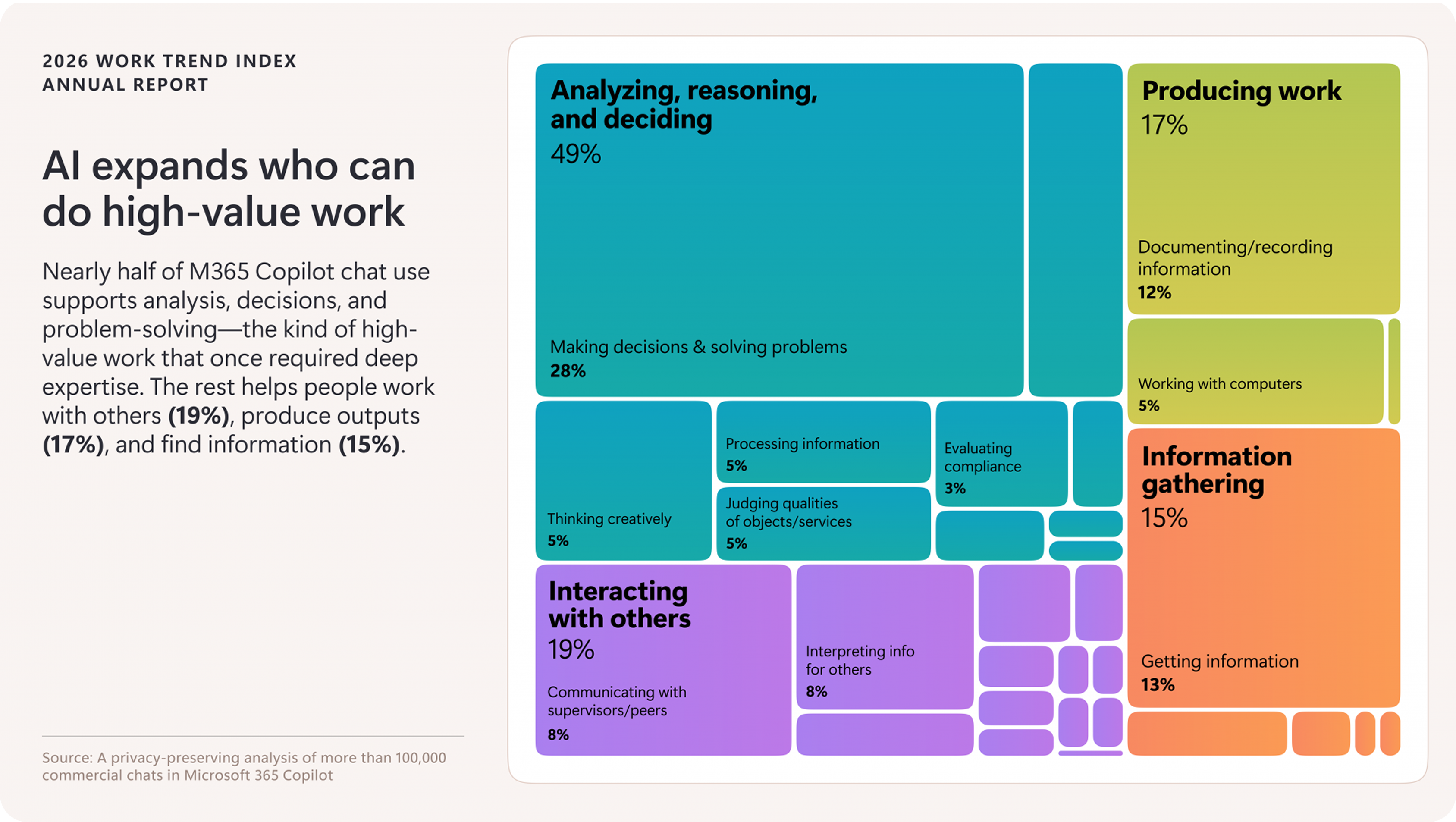
Microsoft 365 Copilot telemetry, one week in February 2026. Percentages show each activity’s share of classified Copilot user goals—not time spent, not session count. Each interaction is classified by user intent against the O*NET Intermediate Work Activities taxonomy and then mapped to Generalized Work Activities (GWA) (underlying filter: IWA share ≥ 0.05% (Counts, S., Chen, Y., Dong, J., Sharma, H., Zaikin, A., Hu, R., Kok, A., and Ozer Yilmaz, G. (2025). ”How people use M365 Copilot Chat.” Microsoft Working Paper.) and grouped into the four O*NET Work Activity Categories: 4.A.1 Information Input, 4.A.2 Mental Processes, 4.A.3 Work Output, 4.A.4 Interacting With Others
What shifts in roles, skills and org structure are you observing as businesses realise AI can now do work that used to define entire functions?
This is one of the biggest shifts we’re seeing because smart organisations are not simply introducing another technology; they’re redesigning how they get work done. AI is not a set-and-forget solution. It needs clear governance, well-designed workflows and ongoing management to deliver value at scale. Without that foundation, AI can quickly become expensive, inconsistent and create more complexity than it removes.
This presents a real opportunity to rethink the role of people and functions within the organisation. As routine execution becomes increasingly automated, human value shifts towards strategy, workflow design, commercial judgement, creativity and decision-making.
The leading organisations getting this right are asking, "What can we automate to empower our people to do the work that creates the most value for our customers?"
At the same time, I believe we're moving towards a future where employees won't just collaborate with each other, they'll orchestrate teams of specialised AI agents. A marketer, for example, could have an agentic team providing competitive research, audience analysis, media optimisation, reporting and content creation with automated moderation. This is a significant shift from tasking to higher-level decision-making to optimise workflows, validating systems to maximise the value chain that supports the all-important customer experience.
What this means operationally and structurally is that organisational boundaries are beginning to disappear. Marketing, technology, data and customer teams can no longer operate independently if organisations want to unlock AI's full potential. This is the revolution that’s required to deliver real business transformation to be commercially successful.
Which industries or types of organisation are moving fastest on AI right now — and what do you think is giving them the edge?
Those who have solid systems and processes running within well-established and documented workflows in place are adopting AI at an accelerated rate, albeit with some hesitation due to the current lack of sufficient security guardrails in place. Financial services, healthcare and enterprise organisations often have stronger governance frameworks, which gives them confidence to experiment responsibly.
We’re also seeing early adoption by ambitious mid-market organisations who are flexible and nimble, able to make decisions faster since they do not have the burden of large, complex legacy systems to impede them.
It’s exciting to see how each tranche of the market is reacting and positioning itself for the future in very different ways. The one thing they all share is that laggards who don’t get on board will be left behind with unprecedented consequences.
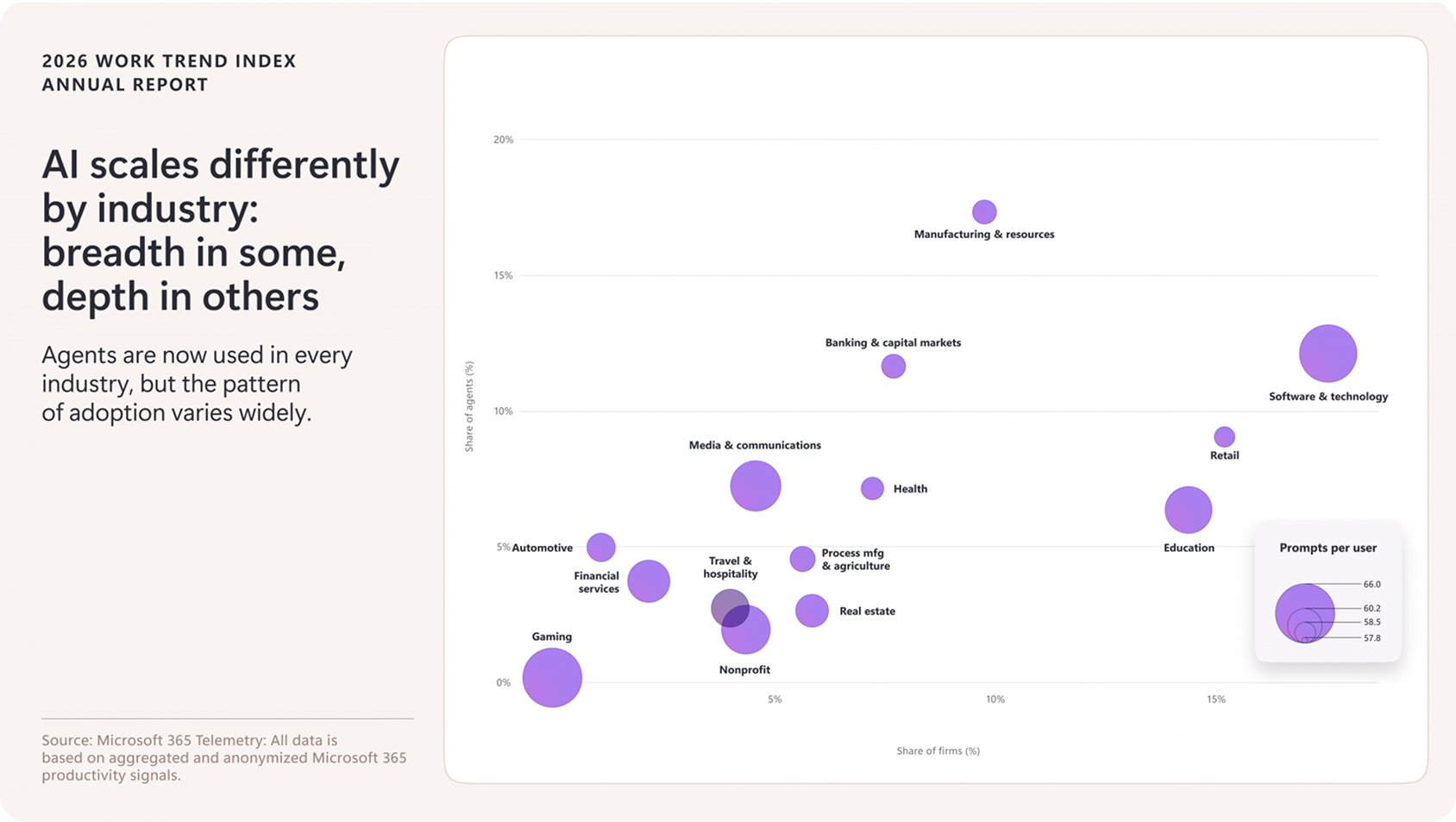
Microsoft 365 Copilot agent telemetry | March 2025 through March 2026 | All metrics expressed as shares and ratios. No absolute counts.
Looking across the market, are most organisations treating AI as a productivity tool or as a new operating model - and where do you see that distinction mattering most?
At this early, bleeding-edge stage of technology adoption, AI is restricted to a productivity enhancement tool and will eventually graduate to a strategic operational (business) model when the existing uncertainties are reduced.
Within the next 12 months, the winners of the AI race will be confirmed. This presents a challenge for marketers since they need to make long-term technology decisions based on dependable and secure operating environments that will continue to exist!
A recent study of 300 global CMOs found that 96% believe AI is driving end-to-end transformation in their function; however, only a third have fundamentally redesigned their operating models, and only 8% are running campaigns in which multiple AI agents operate autonomously.
This is because the introduction of end-to-end agentic workflows is forcing a fundamental reset of the marketing operating model, and the talent gap to make this happen efficiently to manage the rising costs of AI is the hardest problem to solve.
All in on AI signature question: What would your key suggestion and recommendation be as businesses explore how to transform their organisations and what pitfalls or risks are there of not selecting the right technology partner to help unlock its true transformational value?
My advice is simple: Don't start with AI. Start with your marketing system.
Understand how work flows through your organisation. Document your processes. Determine how you can bring your customer data together. Decide what success actually looks like and establish clear governance rules. Then, determine if this is what you want to replicate or need to improve. Now is the time to make the changes that create the unnecessary friction on the customer’s path to purchase and the optimisation of the customer experience (value chain).
The biggest risk is building AI on fragmented data, disconnected technology and inefficient and ineffective processes, perpetuating the problems of the past into the future.
It’s essential to start self-education and the documentation of existing processes to be ready as soon as the security protocols are established. The learning curve with all the tech apps and platforms now available is quite steep.
We have only seen the tip of the AI iceberg. Much like the dot-com wave of 2000 was the catalyst for the internet we know today, AI is even more revolutionary because of its agentic abilities to execute and coordinate tasks and activities that previously were the sole domain of human specialists.
In the media and marketing space specifically, I believe the biggest opportunity is to finally clean up decades of ‘media mess’. Operational fragmentation. Multiple agencies. Disconnected platforms. Complex reports and dashboards. Different definitions of (function-based) success metrics.
AI can change that. AI can empower adept marketers to regain control of their marketing and media advertising with one single view to gain significant operational efficiencies, reduce media wastage to generate much stronger ROI, leveraging the new combination of human and technological resources.
The bottom line is that marketers who are willing to back themselves on this journey of transformation to be the champions of change, embracing the most powerful innovation since the Internet, will be rewarded. They will remain secure in their employment as the priceless and mission-critical agents of change and transformation that they are. Bystanders are unlikely to have any significant role to play.
Responses attributed to Adam Goodman, Director, AI Acceleration, Microsoft Advertising APAC:
Aleisha's perspective reinforces something I hear in almost every conversation with brands and agencies today. The biggest barrier to AI transformation is rarely access to technology. More often, it is fragmented data, disconnected workflows, siloed teams and uncertainty around governance. The organisations making the most progress are the ones taking a step back to redesign how work flows through the business before they scale AI across it.
For brands looking to understand where they are today and what the next stage of their journey should look like it’s why we have developed the Microsoft Advertising AI Maturity Framework. It helps businesses assess their current level of AI maturity and identify the people, process, data and technology capabilities needed to move from foundation to transformation.
Beyond assessment, there are three areas where organisations can take immediate action.
1. First, focus on workflow transformation before tool deployment. As Aleisha highlighted, AI can only automate effective processes otherwise it simply amplifies complexity.
2. Prioritise connected and governed data. Many organisations still operate across multiple systems, teams and definitions of success. Ensure you can stitch together, ideally a single, trusted foundation that allows AI to operate with greater context, consistency and confidence. For retailers your feed is critical, so leveraging things like Microsoft Merchant Center to ensure product data is optimised.
3. Drive adoption and organisational readiness – what we call AI Fluency Training. AI transformation is as much a people challenge as it is a technology challenge. Brands that succeed are building the skills, governance frameworks and operating models needed to empower employees to work alongside AI while maintaining trust, security and accountability.
We have a wealth of supporting documentation and training, from our Advertising Learning Lab through to Microsoft Learn.
The opportunity each of us have ahead is significant. And the brands, advertisers and businesses that combine strong foundations with a clear vision for transformation will be best positioned. It will help them move beyond productivity gains and prompts and unlock the full value of AI across their business, and we are here to support you on that journey.

Your input makes us better
Take our quick 3-minute survey and help us transform your website experience.