How to set an advertising budget for your small business

If you own a small business that’s in its initial growth phase, you know that every dollar counts. That’s why it’s so important for small businesses to set advertising budgets that align with their campaign goals. Specifying where your dollars are going can help you target the right demographic and select which forms of media to use. In addition, creating an advertising budget can help you assess your campaign results and pinpoint your goals going forward.

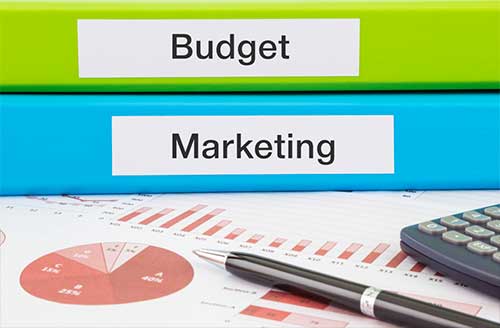
Close up of a desk with a pen, a calculator, and two folders labeled Budget and Marketing.

Identify your advertising goals

Before setting your budget, your business should set some long-term and short-term advertising goals. The first step to setting appropriate advertising goals is knowing and analyzing your sales funnel. The goal of marketing is to bring customers to the beginning of the sales funnel and have them continue until they make a purchase. You can align your marketing strategy with the section of the sales funnel you decide to target—awareness, interest, desire, or action. For example, you can use brand awareness campaigns to build your audience, create interest with targeted ads, build desire in your customers with new content, and prompt them to make a purchase with a call to action (CTA).

Know your target audience

Learning your target audience will ensure your ads reach the right people, or the consumers most likely to be interested in your brand and product. Once your small business knows its target audience, you can analyze their demographics to learn the best methods and places for advertising your goods and services. This means that your ad will only be shown to the people who you’ve determined are the most likely to make a purchase.

Two hands holding a tablet showing the word Budget.

Know your operational costs

When setting an advertising budget, don’t forget to factor in all the operational costs of promoting your business. In addition to the funds you set aside for running the ads, other costs such as paying your employees for performing marketing tasks, third party or sponsorship expenses, and software subscriptions need to factor into your budget. The best way to set an accurate budget and stick to it is by being on top of these lesser-known payments.

Describe the type of advertising budget you want

You can take a few different approaches when setting an advertising budget for your small business. Research each of them to determine which one’s best suited for your overall needs. Once you choose a strategy, you’ll know how to create a number for your budget.

Revenue-Based Advertising Budget

A revenue-based approach to set an advertising budget looks at last year’s sales figures and designates a percentage of that income towards marketing and advertising. In general, most small businesses allocate around 7 to 8% of their gross revenue towards their advertising budget. To calculate this number, simply find your total revenue—the number of products or services sold multiplied by the price of the products or services—and multiply that figure by .07 or .08.

Top-Down Advertising Budget

Using the top-down marketing budget model, your small business’s owners or managers will set a marketing budget based on personal insights and data from previous years. Using this method, the marketing team’s goal should be to stay within the parameters set by upper management.

Competition-Matching Advertising Budget

Another way to set a budget for your small business is by matching the advertising budget of your top competitors or by using the same percentage of your sales revenue as your competition. However, before deciding to match your competition’s budget, research their marketing strategy and see if their campaign goals align with your own. Your small business is unique, so you may need to spend more or less on advertising than your competitors.

Goal-Driven Advertising Budget

Analyzing your small business’s goals is crucial when creating your advertising budget. Setting a goal-driven budget means choosing a budget that’s best suited to help you achieve your goals and assigning a monetary value to each goal. For example, if your small business’s goal is to increase your social media following, estimate the cost of gaining one new follower and multiply it by the total number of new followers you want. If your goal is to attract new customers to your online store, determine the target cost of acquiring a new customer and multiply it by the number of new customers you hope to gain.

Decide how fast you want your business to grow

Every small business needs to evaluate how quickly it needs to earn revenue. If your business is still growing, you may need to invest more money into your advertising budget to potentially get a higher return on investment (ROI) at a quicker pace. For example, businesses that are in their first five years typically spend more on ads than businesses over five years old. In general, young businesses invest between 12% to 20% of their revenue towards marketing. Some even use up to 40% of their total revenue on marketing campaigns. Still, if your small business has time to steadily grow and earn revenue, you might be able to make a long-term budget and spread your ad dollars over multiple years.

A board reading separate single words like ad campaign, budget, statistics, research, design, and content.

Research advertising trends

In addition to researching your competition, conduct research into the current marketing landscape to stay on top of current trends and to structure your advertising budget. Look at economic trends and gaps in the market that your brand could fill, and how the current technology is affecting the way customers shop. For example, are consumers using different methods to browse and make purchases? Are these consumers part of your target audience? If so, you may need to adjust accordingly.


Tools like the Microsoft Advertising Search Network can help analyze how your target audience is searching the web for relevant goods and services. These trends can assist you in deciding where to allocate your budget for the best ROI.

Review the advertising budget on a quarterly basis

Revenues, trends, and resources change, so your small business’s advertising budget might need to change as well. Review your advertising budget quarterly to adjust where necessary.

Get started using Microsoft Advertising

To summarize, follow these seven steps when setting your advertising budget:

  1. Identify your short and long-term advertising goals by analyzing your sales funnel.
  2. Learn your target audience so you know which demographics to target for the best ROI. 
  3. Factor all operational costs into your budget for a more accurate figure. 
  4. Choose between the following advertising budgets: Revenue, competition matching, top-down, or goal-driven. 
  5. Decide how fast you want your small business to grow.
  6. Research current market trends to see which external forces will affect your budget. 
  7. Review your budget on a quarterly basis and adjust as needed.

Microsoft Advertising for small businesses is here to help you accomplish your company’s goals. Let us further assist you in growing your small business by using your advertising budget efficiently. Whatever budget you’ve set, you’re in control—you only pay when a customer clicks one of your ads. We also provide hands-on support to help you optimize campaigns and boost performance around the clock. 

Get started today or visit our blog to learn more.