Blog post
How to steer your brand in AI-powered search

As AI answers more (and sometimes all) of the questions consumers have about brands or products, it’s natural that marketers may feel a loss of control over how AI search is changing how to connect with their audiences.
But the reality is that you're still in the driver's seat. Control has simply moved upstream. So now, it’s in the conversion signals you provide, the feed quality you maintain, and the boundaries you set.
And here's what you can do to shape your brand's AI search experience with clear signals and confidently stand behind the results...
Reframing control in the AI era
According to the Interactive Advertising Bureau's (IAB) 2026 Outlook Study, 73% of marketers now prioritizing content optimized for AI-generated answers. This major shift means that brands recognize how AI is determining creative structure and search visibility across platforms.
In traditional advertising, brands managed outcomes through manual execution and constant correction. In AI-powered search, control comes from things like:
- Providing clear conversion signals that teach AI what success looks like.
- Maintaining feed quality so AI can accurately find and represent your brand.
- Setting red lines defining what isn't acceptable.
By learning from pre-defined signals like structure and objectives that you define and control, AI can deliver more relevant results.
This upstream approach is more efficient and lets you maintain brand trust and safety. And three pillars make it possible: what you can see, what you can steer, and what you can prove...
1. See: Transparency in AI-powered Search
To explain what's happening with confidence, you need to understand where your brand appears, why it shows up, and how performance is shaped by the inputs you provide.
AI learns from conversion signals
The quality and density of conversion signals you provide directly determine how effectively AI can align with your goals. Aim for at least 30 conversions within the past 30 days for the most effective optimization. By guiding the AI’s decision-making process, you can more easily diagnose issues quickly, and monitor placements to adjust as needed.
Transparency as a platform feature
Platforms built with transparency in mind feature dashboards that show your placements and search terms, which signals AI prioritizes, and how conversion density influences optimization decisions.
2. Steer: Conversion signals, feed quality, and clear boundaries
Control in AI doesn’t mean you have to micromanage every single output. With the right inputs, quality feed maintenance, and clear boundaries on what drives value and outcomes through conversion, you can organize your advertising to ensure AI can find and understand your brand.
Making your brand findable
Feed hygiene and ingestion ability are critical to being found and represented accurately in AI-powered search. Feed optimization consists of structuring information clearly with:
- Consistent formatting
- Complete attribute coverage
- Accurate categorization
- Machine-readable signals
Red lines over hard targets
Set practical guardrails around what isn’t wanted or allowed, rather than trying to specify every acceptable option and imposing hard targeting constraints on AI. For example, indicate content to avoid, brand voice controls, negative keywords, off-limits placements, and messaging that crosses legal or ethical boundaries.
3. Prove: The measurability mindset
According to the IAB study mentioned earlier, advertisers are placing greater emphasis on measurement and accountability. Cross-platform measurement has risen to 72%, up from 64% year over year.
Measurability in AI-powered search gives you the proof —and confidence —you need that AI is delivering results aligned with your business objectives and brand standards.
Think of measurement as a learning mechanism that lets AI continuously improve. It creates a feedback loop:
- Measure conversions
- AI learns patterns
- Optimization improves
- Measure the refined outcomes
Conversion-focused measurement
AI-powered search requires measurement systems that consistently track conversions and capture valuable actions and performance. And every conversion signal you track teaches the AI and lets you validate and adjust. Measurement platforms that show how AI -attributed conversions to specific signals can help you make smarter decisions going forward
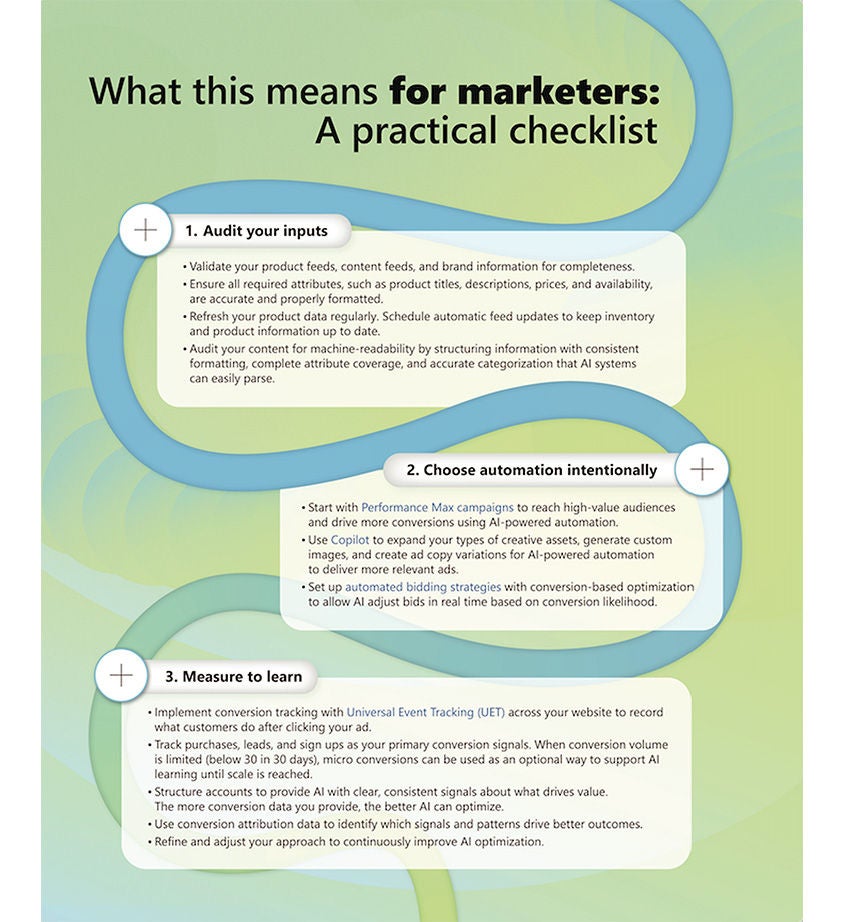
Building confidence through what you control
In AI-powered search, brands can take control and steer AI toward the outcomes they want. Structure your accounts around building conversion density, maintaining feed quality, and using measurement to stay on track. Audit your data quality continuously and be intentional when setting your guardrails.
Platforms designed to keep you visible and in control as you shift upstream to strategic orchestration can help you scale performance while maintaining your brand integrity.
To Learn more about how Microsoft Advertising can help steer your brand in AI-powered search explore our YouTube series on how AI is reshaping search.

Your input makes us better
Take our quick 3-minute survey and help us transform your website experience.