Blog post
Debunking the myth: Is AI-powered search killing ad success?

“AI is going to kill search advertising.”
It makes for good headlines as the customer journey has grown more complex...
People are increasingly getting answers directly on SERPs and through AI answers, bypassing website links altogether. About 80% of consumers now rely on "zero-click" results in at least 40% of their searches. Voice queries are five times more frequent on mobile, according to Microsoft research.1 And visual search has also emerged as a key entry point for product discovery as consumers point, snap, and search.
AI has stepped in to simplify, compare, and turn discovery into purchasing. The worry now is that it’s eroding reach, ROI, and effectiveness.
But is it true?
The reality: AI is amplifying search
Consumers might be turning AI for initial ideas, but they then rely on search to go deeper, compare, and decide.
Three in four people now use AI alongside traditional search.2 And Microsoft found that customer journeys combining Copilot and search grew 85% between 2023 and 20243 and 38% of Copilot users also increased their Bing usage.4
So AI and search aren't in competition... they're one continuous decision journey.
As the way we search has evolved and customer journeys become more complex, brands must now take advantage of the multiple influence moments throughout a consumer's decision process. And the discoverability gap between brands that evolve and those that don't is growing quickly.
How to ensure your brand appears in both AI answers and search results
The good news is that adapting doesn't mean rebuilding your strategy from scratch. Traditional search tactics won't disappear. The approach just needs to evolve beyond rankings and clicks toward visibility, influence, and presence across AI-driven journeys.
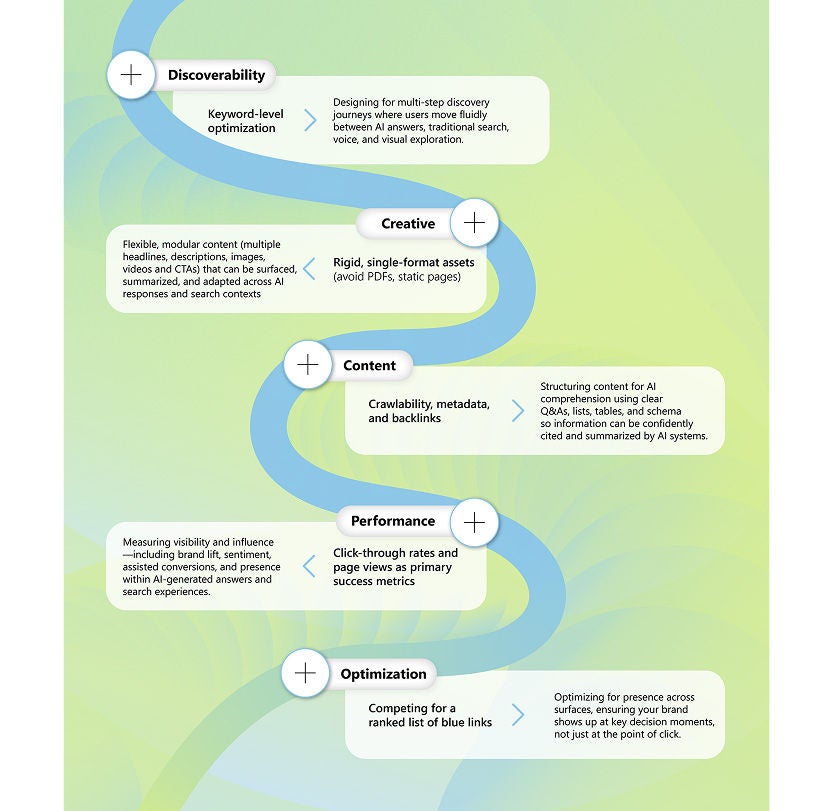
Measuring success in the AI-powered search era
Shifting from click-through rates and page view metrics to brand presence means you show up with contextual relevance that truly influences decisions. The KPIs that capture this are brand lift, assisted conversions, and journey influence.
To build that presence, you should focus on three things:
- Structure for agents, not just users. Ensure your content is optimized to be cited and surfaced by AI systems.
- Deliver value instantly. Give audiences actionable answers, not options to click through.
- Build always-on ecosystems. Move away from one-off campaign messages toward systems that adapt to match each user's intent and serve in real time.
Remember that while zero-click behavior changes measurement, it does not change value. AI and SERP features often answer questions directly, but visibility still drives influence, making multi-touch attribution critical to connect visibility to outcomes. Our data shows a purchase lift of more than 53% within 30 minutes when Copilot is part of the journey.5
Similarly, GEO isn’t replacing SEO, it’s continuing to build on it. Our advice is to stick to your SEO fundamentals, then add GEO strategies by structuring your content for snippets (like Q&As, lists, and tables), applying schema, and monitoring your AI citations and share of voice.
The winning strategic shift: AI is the new front door to demand
At Microsoft Advertising, our capabilities are built to ensure your brand shows up across both original search and generative AI environments:
- Performance Max extends your presence across Bing, MSN, Outlook, Edge, and AI-driven placements—delivering three times the ROAS versus search alone.6
- Broad Match surfaces natural, intent-rich queries while filtering irrelevance and is most effective when paired with auto-bidding.
- Impression-based remarketing re-engages audiences who've seen your ads, without relying on clicks or cookies. Some brands see conversions climb with as few as seven or eight impressions.
- By combining audience intelligence with AI‑powered search signals, Audience Ads deliver *42% higher reach among clickers vs. Search alone.7
Succeeding in this new AI search era means building for new buyer behaviors. It means optimizing for agents as well as human shoppers, building for impressions instead of clicks, and staying open-minded and informed about the changes that are already here.
For more in-depth insights and actionable tips, check out our new comprehensive guide on search and AI: AI search demystified: A practical guide for marketers.
Contact us today to learn how Microsoft Advertising can help you leverage search advertising in the AI era.
[1] Microsoft First Party Data | August 2023 - August 2024
[2] Microsoft First Party Data | Dec 21, 2024 to Dec 31, 2024 | Global | Edge users | 30 minutes before and after Copilot interaction (Measured based on assumed purchases from URL address)
[3] Microsoft First Party Data | August 2023 – August 2024 | Global | Search Only vs. Search + Copilot
[4] Microsoft First Party Data | August 2023 vs. August 2024 , Compared to organic chat response
[5] Microsoft 1P Data | Dec 21, 2024 to Dec 31, 2024 | Global | Edge users | 30 minutes before and after Copilot interaction. Measured based on assumed purchases from URL address
[6] Microsoft internal data, Global, May-June, 2024
[7] Microsoft Advertising. Scenario Lift by Ad Product. Retail vertical benchmark UK. Q4 2024

Your input makes us better
Take our quick 3-minute survey and help us transform your website experience.