Blog post
All in on AI: “Discovery to Influence in GEO” Part 1
Welcome to the third installment of our new leadership series, “All in on AI”. Over the past three months the pace of innovation in AI has accelerated dramatically.
In last month’s article we asked whether AI is “the Ultimate Amplifier”, and in this month’s series we are thrilled to continue digging deep into the key topics, hot on the region’s leaders minds which leads us to today’s key focus area. GEO.
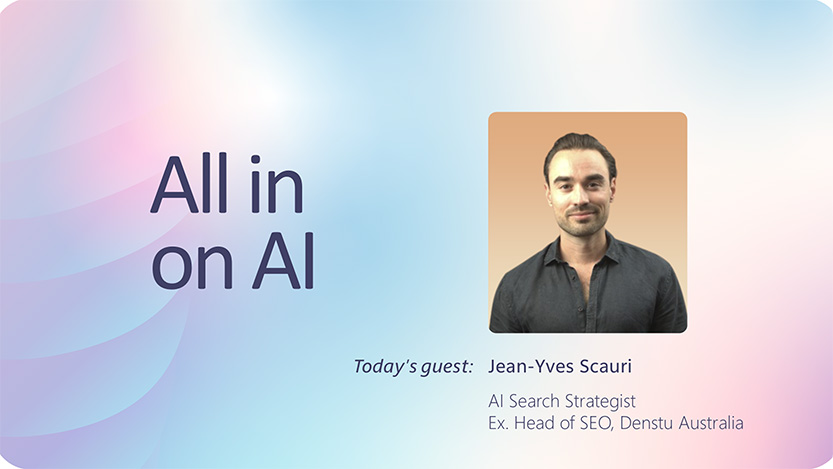
This month I sat with AI Search Strategist, Jean-Yves Scauri, an industry leader who spent the last 15 years working in SEO and search strategy. Jean-Yves, better known in the industry as JY, has spent the past decade leading large-scale programs at Dentsu Australia, helping build and run one of the country’s largest SEO teams and working with some of the region’s biggest brands. So let’s jump all-in and hear his perspective on how brands are thinking about GEO (generative engine optimisation), the importance of SEO (search engine optimisation) and all things, AI.
Responses attributed to Jean-Yves Scauri, AI Search Strategist, ex Head of SEO, Dentsu Australia.
As AI began to change how people discover and evaluate information, my focus shifted from rankings and traffic to how visibility, trust, and influence are formed inside AI-driven systems. In my agency role, I became the de facto AI lead, working closely with clients to interpret these changes and translate them into practical guidance rather than speculation.
Today, I work independently with ambitious, fast-growing brands, helping them navigate this new discovery landscape by combining deep SEO experience with real-world AI strategy.
How do you think the rise of AI assistants, browsers, and agents changes what it means for a brand to be discoverable, and how does influence shift when AI decides what gets surfaced?
Discoverability is shifting from “can a search engine find you?” to “does an AI understand you well enough to confidently explain or recommend you?”
In traditional search, brands competed for a position on a results page. In AI-driven discovery, brands are competing for clarity. Clear signals about who you are, what you stand for, and when you are relevant.
These systems don’t just crawl pages. They build a picture of who is credible by combining what’s on your site with signals from across the wider web, including publishers, reviews, structured data, and other trusted third-party sources.
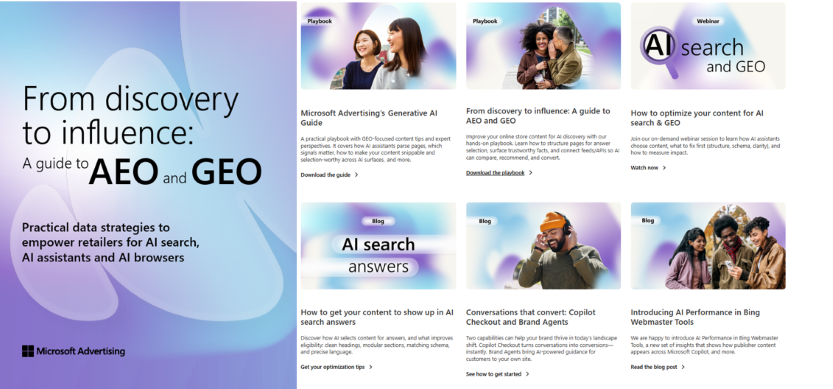
When AI decides what gets surfaced, influence moves away from content or backlink volume and toward evidence, consistency, and clearly demonstrated authority across the ecosystem.The brands that show up are the ones that are easiest for AI systems to understand, verify, and trust. This shift from discovery to influence is something Microsoft has explored in more depth in its guide to AEO and GEO.
"For brands today, being discoverable increasingly means:
- making information easy for AI systems to extract and interpret
- owning topics deeply rather than publishing thin content
- earning presence in sources AI already rely on"
Traditional web search engines still dominate discovery by total volume, but early data suggests a meaningful and growing share of learning and decision-shaping queries are now happening inside AI assistants like ChatGPT, Gemini and Copilot.
Why do you think so many brands still fail to show up in AI answers despite having the data signals AI relies on, and which gaps matter most for AEO/GEO readiness?
Having signals isn’t the same as having a coherent narrative.
The most common issue I see isn’t a lack of content or technical foundations, but fragmentation. Brands often have strong signals spread across websites, product pages, blogs, PR coverage, and social channels, yet those signals do not reinforce a clear picture of who the brand is and what it is trusted for.
This fragmentation tends to show up in 3 places:
1. Accessibility: Information exists, but it is difficult for AI systems to consistently extract, interpret, or reconcile across formats and pages.
2. Content architecture: Brands publish plenty of material, but it is not organised in a way that clearly reinforces a small number of core topics or areas of expertise.
3. Ecosystem consensus: What the brand claims on its own channels is not consistently reflected or validated across the wider web.
AI can aggregate huge amounts of information, but it struggles when signals are vague, contradictory, or diluted. When a brand doesn’t clearly reinforce its expertise in a few core areas, the system naturally defaults to sources that do.
Recent research from Profound highlights this gap. It found that only around 4% of AI citations come from a brand’s own website, with the vast majority coming from third-party sources AI already trusts. Most brands already have plenty of signals. The problem is those signals don’t line up clearly enough for AI to understand what the brand is trusted for.
Which part of the GEO funnel do you believe brands underestimate the most, and why does that matter?
Most brands underestimate the top of the funnel. I am seeing more teams start to deprioritise early-stage, informational content because AI now answers many of those queries directly. If users are not clicking, the thinking goes, why keep investing? Research from Ahrefs helps explain where this thinking comes from. Their analysis of AI Overview results shows that the vast majority are triggered by informational queries. That has led many teams to assume top-of-funnel content no longer matters.
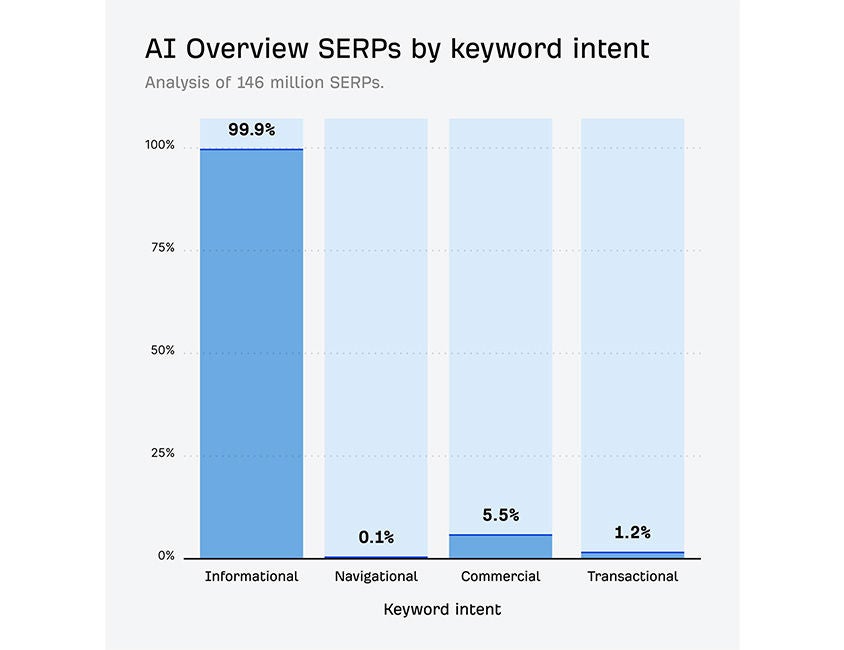
Source: Ahrefs
But that conclusion misses the point. It does not make top-of-funnel content irrelevant. It makes generic top-of-funnel content irrelevant. Anything that can be easily summarised or reproduced has become a commodity. The real value now sits in content that is difficult to replicate: original data, expert perspectives, real-world experience, case studies, and strong visuals.
More importantly, this is where AI systems form their understanding of a brand. Early-stage content shapes how the model categorises you, what you are considered credible for, and whether you are even eligible to be recommended later in the journey. If a brand is weak at this stage, it is often filtered out before consideration begins. In AI search, the top of the funnel determines who gets to compete at all.
Understanding how AI decides what to surface is step one. In Part 2 of this conversation with JY, we explore what this means in practice - how brands should rethink content, structure, measurement, and metrics to stay visible and credible in an AI‑driven world.

Your input makes us better
Take our quick 3-minute survey and help us transform your website experience.