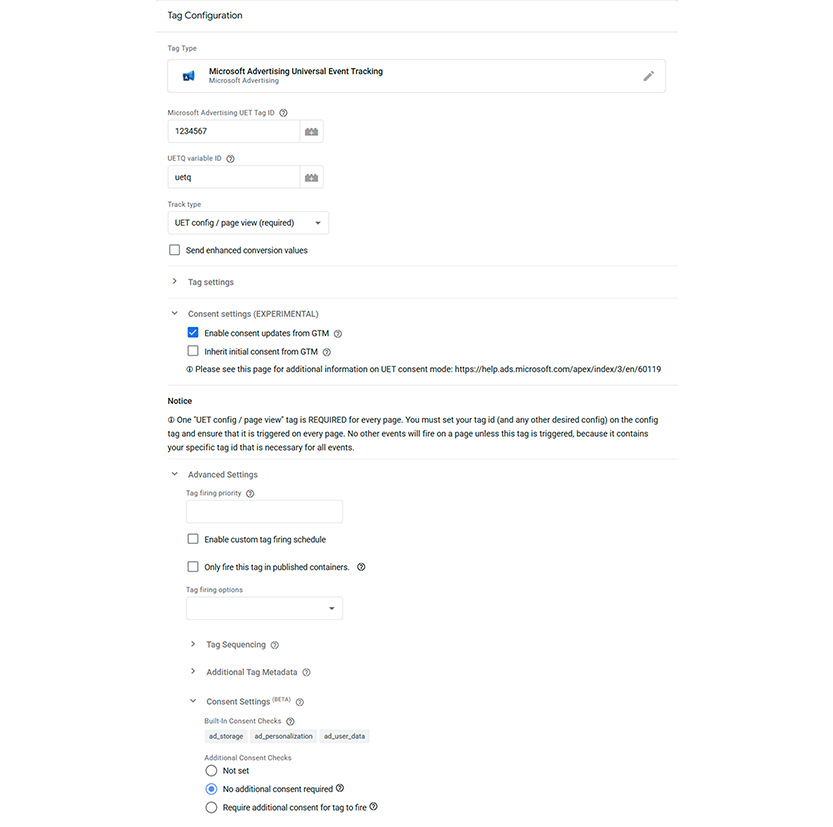
If you’re using a consent platform such as OneTrust, Cookiebot, or Usercentrics, consent signals are typically passed into GTM automatically, but we suggest you verify this flow. UET reads the consent state directly, no custom scripting required.
However, it’s important to note that some CMPs are configured to block marketing tags entirely until consent is granted. In certain setups, this may include UET. If your CMP prevents UET from loading at all before consent is obtained, ACM can’t function correctly because the tag won’t have the opportunity to read the default consent state.
If this applies to your configuration, work with your CMP provider to ensure that UET is allowed to load on page load rather than being fully blocked. UET will respect the denied default state and will not set advertising cookies unless consent is granted, but it must be allowed to execute to enforce that behavior.
If you’re using a custom implementation (without GTM), the same principle applies: Place UET in the <head> above the CMP script and define the default consent state as denied.
Even if an explicit “denied” signal is not sent, enforcement occurs on Microsoft’s side. However, clearly defining the default state remains best practice.
Principle 2: Send “granted” when consent is obtained
When a user grants consent, UET must receive an explicit update to “granted.” This must occur every time consent is given and on every page where consent is active.
In most modern setups, this should happen automatically. CMPs like OneTrust, Cookiebot, and Usercentrics can be configured to pass consent signals directly into GTM, where UET reads and applies them in real time.
If this update isn’t sent, UET will remain in denied mode and continue operating cookieless.
That behavior is privacy-safe, but will limit measurement depth. Ensuring the “granted” update fires properly allows full functionality when the user has made a positive choice.
Verifying Your Setup
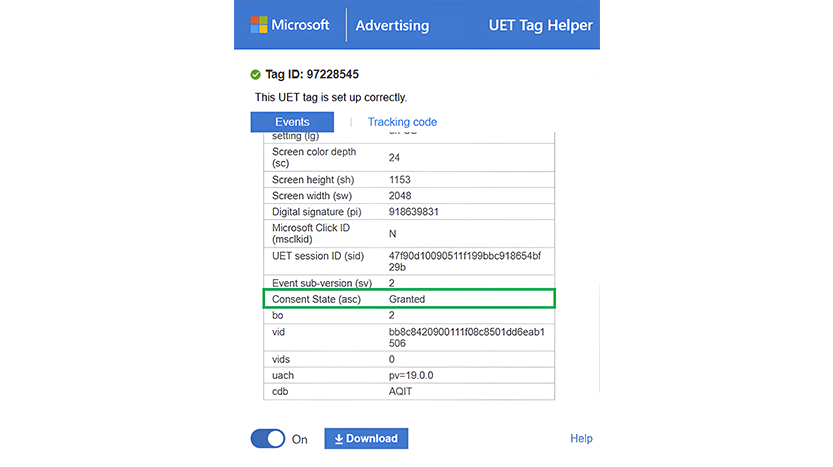
Once implemented, verification takes minutes. Use the UET Tag Helper browser extension to confirm that:
- UET loads before the consent banner
- The default consent state is denied
- The status updates to “granted” after user approval
- No advertising identifiers are attached to requests when consent is declined