Blog post
Channel Partner Spotlight: FeedOps, winners of Microsoft Advertising's 2025 AI Innovation Award

FeedOps is a product data optimisation platform purpose-built for retail advertisers. Based in Australia, we help e-commerce businesses and agencies improve the quality and performance of product feeds for Microsoft, and other shopping ad platforms.
As an elite channel partner of Microsoft Advertising’s since 2021, and winner of the 2025 Partner Awards for AI Innovation in Asia-Pacific, our sole focus is on the data foundation that powers AI-driven advertising. By enriching, diagnosing, and fine-tuning product attributes, we help brands maximise ad relevance, reach, and profitability.
In today’s retail environment, where Return on Ad Spend (ROAS) is king and every marketing dollar is scrutinised, retailers can’t afford wasted spend. The key to sustained success isn’t just more ads or bigger budgets - it’s better data.
We specialise in optimising the one thing that underpins every campaign’s performance - the product feed. This is the dataset that tells Microsoft Advertising exactly what you sell, who it’s for, and why it’s relevant.
Why This Matters for Australian Retail
Australian shoppers love a deal. In a time when cost-of-living pressures are high, promotions and discounts are more sought after than ever. Retailers know that strong offers work — but they’re worthless if customers never see them.
According to the Commonwealth Bank of Australia “Consumer Insights Report”, 90% of Australians are adopting deal-seeking behaviours and reviewing their spending choices.1 And from the PwC Australia “Voice of the Consumer 2025” Survey: 74% of Australians identify rising living costs as a major concern, with 55% feeling financially insecure.2

These findings underline the critical importance of visibility. Even the best offer won’t drive sales if it fails to appear at the right moment.
In many cases, promotional products fail to appear in search results or online ads because of incomplete or mismatched feed data. Missing attributes, poorly structured titles, or incorrect categorisation can cause AI to skip over a product, even if it’s exactly what a shopper is looking for.
This challenge goes beyond advertising - it impacts how product information is interpreted, retrieved, and presented across AI-driven experiences. AI tools like Microsoft's Copilot depend on structured, accurate data feeds to deliver relevant results in shopping searches, chat recommendations, and summaries. When attributes like brand, category, or price are complete and consistent, products are more likely to align with shopper intent and gain visibility. Investing in data quality ensures that products are surfaced effectively, creating better outcomes for both shoppers and sellers.
Behind the scenes, Microsoft’s AI systems perform hundreds of micro-searches and contextual analyses during a single Copilot interaction. These checks validate product data, compare it against verified sources, and score each item for completeness and relevance. When a feed lacks detail or contains errors, those signals weaken the product’s confidence ranking - reducing its visibility in both Copilot results and Microsoft Shopping Ads.
By fixing these issues, we make sure deals are discoverable. For example, if a retailer is running a 20% off sale on “lightweight waterproof hiking jackets,” our optimisation ensures that those words - and the associated product attributes - are in the feed, so the product is surfaced in both Shopping and Audience Ads when a user searches for it.
Tech Talk: How We Optimise Feeds for Microsoft AI
Our process is built for both scale and precision.
We start by connecting directly to retailers’ ecommerce platforms via APIs. From there, we publish product data to Microsoft Advertising using the Merchant Center Content API. Before anything is sent to Microsoft, it’s transformed by a combination of large language models (LLMs) and our own proprietary algorithms.
These enhancements include:
Deep categorisation — Assigning each product to the most accurate Microsoft category to improve matching accuracy
Natural language title rewriting — Crafting titles that sound conversational, match real shopper search terms, and work seamlessly in Copilot experiences
Attribute enrichment — Filling in missing GTINs, brands, sizes, colours, genders, and other key fields
Custom label creation — Tagging products for high-ROAS performance, seasonal trends, or promotional campaigns so advertisers can segment strategically
Once optimised, feeds sync with Microsoft up to 24 times per day, ensuring that inventory, pricing, and availability are always accurate. This real-time freshness means shoppers never see an out-of-stock item or outdated price - a simple detail that can have a big impact on conversion rates.
Performance Max and the AI Advantage
In ecommerce advertising, Microsoft’s Performance Max (PMax) campaigns are a powerhouse. They combine advanced matching and bidding algorithms with astonishing AI capabilities that automatically generate headlines, descriptions, and ad placements across the Microsoft network.
It’s an impressive combination - but there’s a catch: AI is only as good as the data it’s given. Even the most sophisticated bidding models and creative generators can’t fix incomplete, inconsistent, or misaligned product data.
That’s where FeedOps steps in.
We diagnose feed issues, enrich missing attributes, and align product data so Microsoft’s AI has exactly what it needs to make smarter, more profitable decisions. The better the feed, the better the AI’s matching, bidding, and creative output.
For retailers, that translates into:
Higher CTR (more people clicking on your ads)
Better conversion rates (more shoppers buying)
- Improved ROAS (more revenue for every advertising dollar spent)
The Results
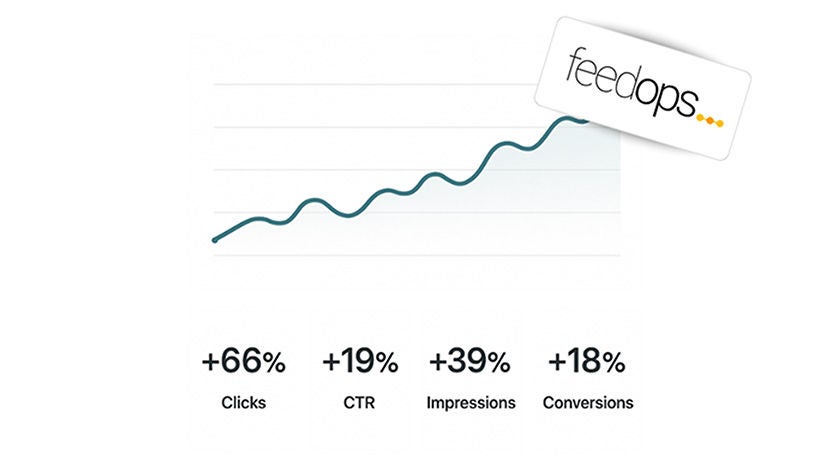
From May 2024 to May 2025, our feed optimisation for Microsoft Advertising delivered measurable, scalable improvements:
+66.17% Clicks (499K → 830K)
+19.05% CTR (1.05% → 1.25%)
+39.60% Impressions (47.6M → 66.5M)
+18.06% Conversions (67K → 79K)
Spend up only 20.93% - a sign of greater efficiency and better ROI
Future-Proofing for Copilot and Retail Media
Microsoft is rapidly expanding into Copilot-powered shopping experiences and Retail Media placements, both of which will rely heavily on structured, enriched product data.
Because FeedOps focuses entirely on feed quality, our clients’ products are already aligned with Microsoft’s evolving standards. That means they’re ready to take advantage of new ad formats and placements as they launch, without any last-minute scrambling to update their data.
If you want to see how feed optimisation can improve your Performance Max campaigns on Microsoft Advertising, book a free demo at FeedOps.com. We’ll walk you through your own product data, highlight exactly where improvements can be made, and show you how to set up for sustained growth.
With the right product data in place, Microsoft’s AI can do what it does best: find the right shopper, at the right time, with the right offer - driving measurable results for your retail business.
[1] Consumer Insights Report, 2023
[2] Voice of the Consumer Survey 2025, PWC, September 2025

Your input makes us better
Take our quick 3-minute survey and help us transform your website experience.